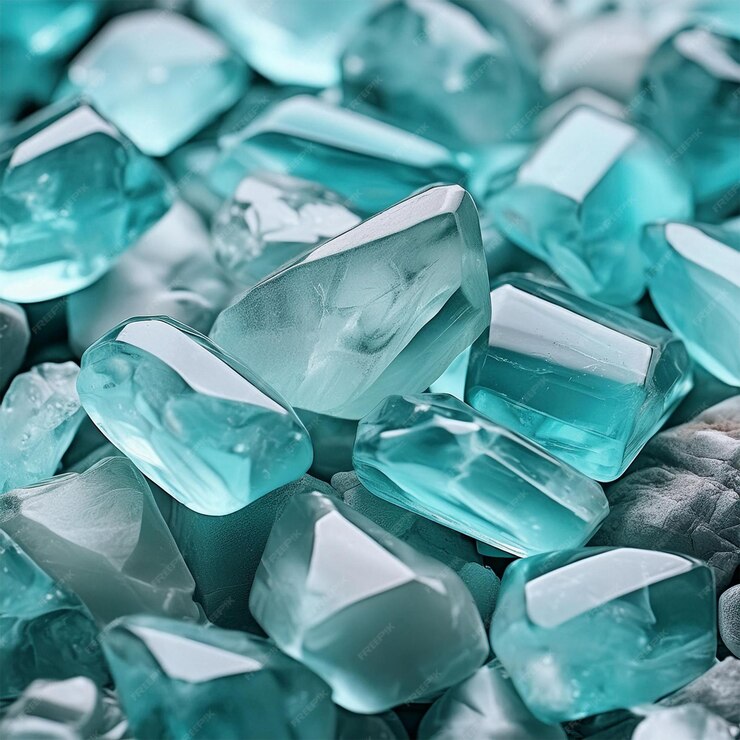
The March birthstone Aquamarine is known as the gemstone of Serenity and the Sea. With its captivating blue to blue-green hue, it is a gemstone that has long enchanted enthusiasts and collectors.
Aquamarine is a variety of the mineral beryl, the same mineral family that includes emerald. Its name is derived from the Latin words “aqua” (water) and “marina” (sea), a fitting descriptor for its ocean-like color. The gemstone ranges from a pale blue to a deep blue-green, with the most valuable stones exhibiting a pure, intense blue.
The allure of aquamarine lies in its clarity and brilliance. It typically forms large, flawless crystals, making it a favorite among gem cutters who can fashion it into various cuts and shapes. Its reflective properties add to its appeal, creating a bright and sparkling appearance when properly faceted.
Several features contribute to the value and desirability of aquamarine:
- Color – The most prized aquamarines have a rich, deep blue color. Lighter stones are also valued but generally less so than their more intensely colored counterparts.
- Clarity – Aquamarines are known for their high clarity and transparency. Eye-clean stones, free from visible inclusions, are highly sought after.
- Cut – A well-cut aquamarine maximizes the stone’s brilliance and color. Common cuts include emerald, round, and oval, though more creative shapes are also popular.
- Size – Aquamarine crystals can grow quite large, allowing for substantial carat weights. Larger stones with excellent color and clarity can be exceptionally valuable.
Some aquamarines may undergo heat treatment to enhance their color or clarity. However, high-quality, untreated stones are highly prized by collectors and connoisseurs.
Mining and Sources
Aquamarine forms from magma, molten rock deep within the Earth’s crust. This magma is rich in silicon, aluminum, and other minerals. As the magma cools, it begins to solidify and form crystals, a process called crystallization. The crystals grow as the magma continues to cool and solidify.
Aquamarine often forms in areas where there is hydrothermal activity, such as near hot springs or volcanic vents. Hot water rich in minerals and metals flows through the rocks, depositing minerals as it cools.
Aquamarine is primarily mined from pegmatite deposits, where it forms in cavities or veins. Mining methods can range from traditional hand tools to more modern mechanized techniques, depending on the location and scale of the mining operation.
Notable sources of aquamarine include:
- Brazil – The most significant producer, particularly known for its Santa Maria aquamarine, which boasts a deep, saturated blue color.
- Madagascar – Produces aquamarines with a unique blue-green hue.
- Pakistan – Known for high-quality, vivid blue stones from the Shigar Valley.
- Nigeria – Offers a range of colors, from blue to blue-green.
- Russia – The Ural Mountains yield some fine aquamarine specimens.
Aquamarine in History
Aquamarine has a rich history that dates back thousands of years, with significant cultural, symbolic, and spiritual meanings attached to it.
In Greek mythology, aquamarine was associated with the sea god, Poseidon, and was said to be the gemstone of the mermaids. The Romans believed that aquamarine had the power to protect sailors and ensure safe passage across the seas.
During the Middle Ages, aquamarine was believed to have the power to protect against evil spirits, storms, and sea monsters. It was also thought to have the ability to calm the waves and bring good fortune to those who wore it.
Several notable aquamarines have captured the public’s imagination:
The Dom Pedro Aquamarine
The largest cut aquamarine in the world, weighing 10,363 carats, was cut from a crystal originally weighing approximately 60 pounds (27 kg) and measuring almost 2 feet (0.61 m) in length.
The stone was mined in Pedra Azul, in the state of Minas Gerais in Brazil around 1980, and named after the Brazilian emperors Pedro I and Pedro II. The blue-green gemstone was cut into an obelisk form weighing 10,363 carats. The jewel was donated to the Smithsonian Institution and is currently on display there.
The Martha Washington Aquamarine
The Martha Washington Aquamarine is named after Martha Washington, the wife of George Washington, the first President of the United States. The gemstone was given to her as a gift in the early 19th century. It is a massive 10,363-carat (2.07 pounds) aquamarine crystal, making it one of the largest and most impressive aquamarines in the world.
The gemstone has a beautiful pale blue color, characteristic of high-quality aquamarines, and said to be reminiscent of the clear blue waters of the ocean. It is cut into a rectangular shape, with a flat base and a pointed top. The cut is designed to maximize the gemstone’s size and display its beautiful color.
The gemstone has been owned by several prominent families and collectors over the years, including the Washington family, the Vanderbilt family, and the Rockefeller family. The Martha Washington Aquamarine is considered one of the most valuable gemstones in the world, with an estimated value of over $100 million.
The gemstone is currently on display at the Smithsonian Institution’s National Museum of Natural History in Washington, D.C., where it is seen by millions of visitors each year.
The Queen Elizabeth II Aquamarine Tiara
The Queen Elizabeth II Aquamarine Tiara is a stunning piece of jewelry that has been worn by Queen Elizabeth II on several occasions.
The Queen received the Aquamarine Tiara as a 41st birthday present from her husband, Prince Philip, Duke of Edinburgh, in 1953. The tiara was designed by the renowned jeweler, Garrard & Co, and features 11 large aquamarine stones, which are surrounded by diamonds. The aquamarines are said to be of exceptional quality and are a deep blue color. The tiara has a unique design, with the aquamarine stones arranged in a series of graduated curves. The diamonds are set in a platinum frame, which adds to the tiara’s elegance.
The Queen is known to be particularly fond of the Aquamarine Tiara, and it’s often considered one of her favorite pieces of jewelry!

